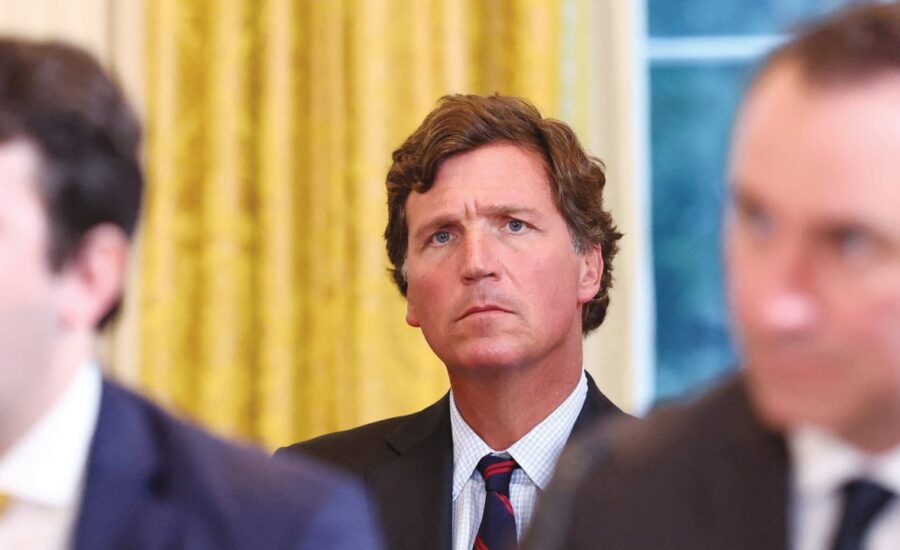
The Trump administration’s involvement in arranging an on-camera conversation between Tucker Carlson and US Ambassador to Israel Mike Huckabee was not a throwaway media gesture.
It was a recognition that a specific problem on the American Right has grown too large to ignore: the steady normalization of Israel-baiting conspiracies and antisemitic insinuations, pushed not only from the margins but by influential voices with massive audiences.
For an administration that owes much of its political energy to the Right’s media ecosystem, nudging one of that ecosystem’s biggest stars into a public exchange with its ambassador was a sign that the issue is very real and being taken seriously.
The Jerusalem Post has pointed out the Israel and antisemitism divide on the American Right time and time again. This paper has also criticized prominent Republicans, including JD Vance, for avoiding direct confrontation with right-wing antisemitic rhetoric, even as they posture as champions of moral clarity.
That avoidance has consequences: it tells activists, streamers, and opportunists that they can lace their arguments about Israel with familiar tropes and still be welcomed as part of a respectable coalition.

That is what made the Carlson-Huckabee meeting worth attempting. The hope was obvious: expose Carlson, in Israel, across from a Trump-appointed ambassador, to facts and context that could puncture the worst caricatures.
Carlson flew in for only a short visit, conducted the interview at Ben-Gurion Airport, and did not travel farther into the country. The idea seemed to be to create a clear, controlled moment of engagement, without theatrics and without the friction of a full trip.
Instead, the interview and what followed showed that good intentions alone won’t solve this problem.
Prosecutor with a pre-written indictment
Carlson arrived not as a curious interviewer but as a prosecutor with a pre-written indictment.
One of the starkest moments came when he insinuated that President Isaac Herzog “apparently was at Pedo Island,” a smear-by-association tied to Jeffrey Epstein. It was not presented with evidence, context, or restraint, just a baseless claim formulated from an AI photo that has been heavily debunked. Huckabee did not validate it, but the damage was in the act itself: a mainstream right-wing celebrity floating a defamatory insinuation about Israel’s president as though it were a responsible inquiry.
Carlson also pushed a claim about Christians in Israel that collapses under the most basic demographic reality. He asserted that Christians are “far fewer in absolute numbers” than at Israel’s founding, using the line to frame Israel as a place that shrinks and endangers Christian life.
The record shows something different: the Christian population has grown in absolute terms over the decades, while its percentage share shifted as other communities grew faster. The point is not to litigate a spreadsheet. It is to show a pattern: take a complicated reality, sand off the nuance, and present it as evidence of moral rot.
Then came the broader framing that has made Carlson a central node in the Right’s anti-Israel turn: the suggestion that American support is not a strategic partnership but a kind of civilizational subsidy, underwriting Israel’s “cultural and religious life” and, by implication, its internal social choices.
This is a familiar maneuver. It encourages viewers to see Israel not as an ally facing Iran, Hezbollah, and Hamas, but as an alien project extracting resources and imposing values. It is the gateway drug to the older insinuations that always follow: who benefits, who controls, who pulls the strings.
If the interview revealed the posture, the airport episode revealed the strategy. Just a few hours after the conversation was filmed, Carlson claimed he was “detained” at the airport for undergoing a routine security check that all passengers go through.
Footage spread on social media later showed what really happened: routine questioning in a private setting, Carlson smiling, signing paperwork, and posing for photos.
That sequence shows the bridge was never meant to hold. Even when offered a controlled, face-to-face conversation with the administration’s ambassador, Carlson always intended to provoke even further. That is not a failed conversation. It shows that the conversation was never the point.
The administration deserves credit for recognizing the seriousness of antisemitism on the Right and the Israel divide feeding it. But the Carlson–Huckabee experiment also taught a lesson: outreach to a bad-faith megaphone does not tame the megaphone. It sharpens it.
The intention was good. The experiment failed. The next step must be something firmer than another invitation.