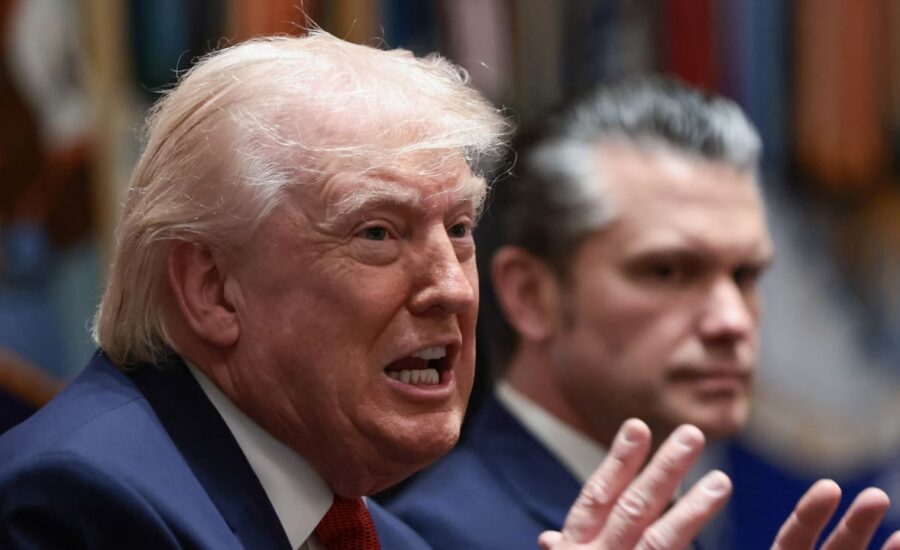
Iran’s enriched uranium stockpiles are deeply buried in a way that would make them difficult to raid, US President Donald Trump told CBS News on Tuesday.
“I don’t even think about it. I just know that, you know, that’s so deeply buried it’s gonna be very hard for anybody,” he said.
The US President also addressed the ongoing tensions surrounding the Strait of Hormuz, saying that other countries need to come up and take their oil, echoing a post he made on Truth Social that day.
“If they want oil, come up and grab it. There’s no real threat, there’s no substantial threat because the country [Iran] has been decimated,” he claimed.

In a press conference on Tuesday, Defense Secretary Pete Hegseth, alongside Joint Chiefs Chairman Gen. Dan Caine, said that there are currently many more ships sailing through the Strait of Hormuz than there had been previously, adding that Trump had threatened Iran in order to allow it to be opened.
“We would much prefer to get a deal. If Iran was willing to relinquish material they have and ambitions they have, open the strait – that’s the goal,” Hegseth said.
“We don’t want to do more militarily than we have to. But I didn’t mean it flippantly when I said that in the meantime, we’ll negotiate with bombs.”
Hegseth also stated that the upcoming days of Operation Epic Fury would be “decisive.”
When asked about the potential duration of the war, Hegseth refused to give a concrete timeline.
“He [Trump] said four to six weeks, six to eight weeks, three – It could be any any particular number, but we would never reveal precisely what it is, because our goal is to finish those objectives, and we’re well on our way,” he said.
“It will be the president’s determination and the president’s determination alone when those objectives are complete and when it serves the interest of the American people to cut that deal to make sure that Iran doesn’t have a nuclear capability, and ultimately that our objectives or our interests are advanced,” he added.
He also described a recent visit he’d made to the Middle East to meet US troops stationed there, saying he’d spent around half a day “on the ground,” but refusing to name the specific locations due to “reasons of operational security.”
The US soldiers had high morale, Hegseth claimed.
“Nobody said better equipment,” he said. “Nobody said more comfortable living conditions. Nobody said, ‘Send me home.’ Well, of course, eventually we want all those things they do too.”
“But what those Americans said to me, young and old, officer and NCO, male and female, black and white, was, ‘Let’s finish the mission. Get us even more bombs, bigger bombs, more targets.”
Iran yet to respond to US 15-point proposal
Iran has yet to respond to the president’s 15-point proposal, according to two sources familiar with the details who spoke to The Jerusalem Post.
One reason is an ongoing dispute at the highest levels of government between hardliners—such as Revolutionary Guards commander Ahmad Vahidi and Parliament Speaker Qalibaf—and figures seen as relatively more moderate, including President Pezeshkian and Foreign Minister Araghchi. For now, the hardliners appear to have the upper hand.
In Israel, officials assess that Iran’s response—if and when it comes—will make negotiations more difficult. At the same time, President Donald Trump has said in various interviews that the talks are progressing well.
Meanwhile, Pakistan, acting as the main mediator between the United States and Iran, has jointly announced a new initiative with China aimed at ending the war. The proposal includes five points: an immediate ceasefire, the start of negotiations, a halt to attacks on non-military targets, the reopening of the Strait of Hormuz, and the establishment of a peace agreement based on the principles of the UN Charter.
The proposal was presented following talks between Pakistan’s Foreign Minister Ishaq Dar and his Chinese counterpart, Wang Yi. According to a statement from China’s Foreign Ministry, the visit was intended to “strengthen” cooperation between China and Pakistan regarding the ongoing conflict in Iran and to “make new efforts toward advocating for peace.”
Netanyahu says US can handle Strait of Hormuz by force
Prime Minister Benjamin Netanyahu also addressed the crisis in the Strait of Hormuz on Tuesday, stating that the US can “handle this by force. They can be bypassed by diverting the energy pipelines from Iran to Israel via Saudi Arabia.”
Netanyahu also added that “the Iran of today is not the Iran of 30 days ago. There is no comparison,” and emphasized that the situation that has arisen constitutes “a rare opportunity for a broad regional alliance with Arab and neighboring countries.”
Yehuda Shlezinger contributed to this report.