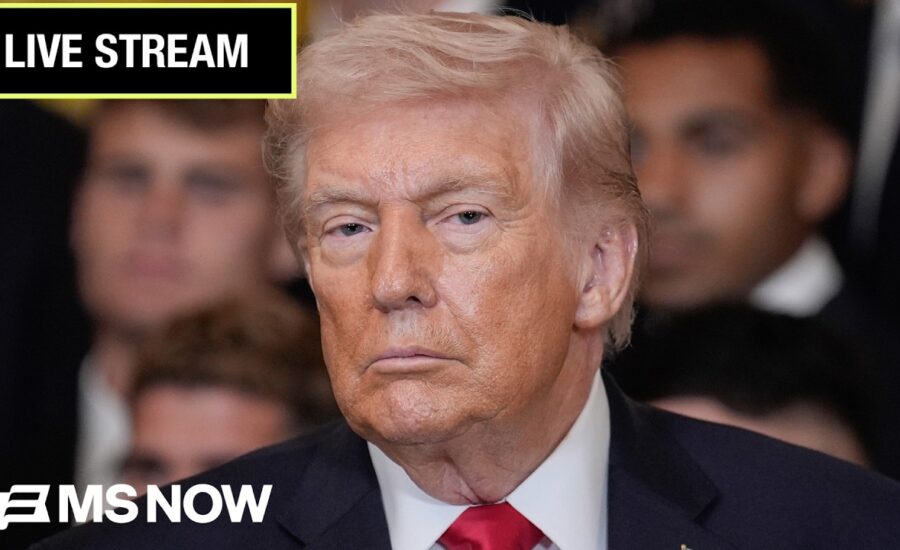
Because he’s apparently not fully occupied with the war he started that’s shaken up the world, President Donald Trump signed an executive order concerning college sports Friday that reveals yet another megalomaniacal fantasy. Just as the Final Four, the culmination of college basketball’s billion-dollar tournament, was about to tip off, Trump demanded a return to yesteryear: When players didn’t get paid. When, unlike every other college student, they couldn’t move from one school to another without penalty. When disproportionately Black basketball and football teams had to do whatever the white men ruling the roost decreed.
Trump signed an executive order concerning college sports Friday that reveals yet another megalomaniacal fantasy.
The president’s executive order says it’s intended “to bolster the effectiveness of key college-sports rules on transferring, eligibility, and pay-for-play by evaluating whether violations of such rules render a university unfit for Federal grants and contracts … establishing clear, consistent, and fair eligibility limits, including a five-year participation window … banning improper financial arrangements including pay-for-play …”
But it’s more properly seen as an attempt to put Black athletes in their place.
The University of Michigan Wolverines, who won the national college basketball championship Monday night, and the University of Connecticut Huskies they defeated will, for the first time ever, share in the millions of dollars they reaped for the NCAA’s Final Four. But if Trump’s retrograde executive order were the rule, they couldn’t.
The Wolverines would have just gotten a commemorative ring, a grab bag, a ball cap, a T-shirt and an “attaboy” pat on the back. That’s what the winners of the tournament got for decades.
Ten of the 16 players on Michigan’s championship-winning squad, including four of the five starters, are Black. The Huskies team they defeated is predominantly Black too. The demographics of basketball and football, college athletics’ only profitable sports, have for decades colored the country’s perception of what those athletes deserve and how they should be treated.
As Christian Collins, a Center for Law and Social Policy analyst in Washington, wrote three years ago about the racial economics of college sports: “From 2005 to 2019, Black college athletes across men’s and women’s basketball and men’s football in the largest five athletic conferences are projected to have lost between $17 [billion] and $21 billion in compensatory theft, or roughly $250,000 per athlete per year, if revenue sharing in collegiate athletics modeled that of professional sports leagues. College athletic programs are often complicit in the economic exploitation of underrepresented student populations.”
Similarly, academics Ellen Staurowsky and Joel Maxcy, when both were at Drexel University, fought for fair treatment of college athletes, and those athletes have gotten some liberation in the form of the protection of their athletic scholarships. Most famously, they have won the right to cash in on their own athletic celebrity, as their own schools had been doing, by getting paid for the use of their name, image and likeness.
And just this season, after another legal victory, college athletes won a share of the billions of dollars they produce that can make their coaches, athletic directors and college sports commissioners millionaires several times over. Those billions also finance women’s college sports and sports young Black men largely don’t play, such as golf (this president’s favorite), tennis, lacrosse and ice hockey.
At a symposium we participated in at Vanderbilt University in February, Duke University anthropologist Tracie Canada, author of “Tackling the Everyday: Race and Nation in Big-Time College Football,” said, “I see small movements that athletes are making, small changes of looking at the ways that athletes are speaking out about how they are identified.” She continued: “‘Am I a worker? Am I an athlete? Am I a student? How am I positioned at this university?’ Making decisions for themselves that might not benefit the institution, might not benefit their team, but they might benefit them individually as athletes who have to make decisions for themselves, because they are the ones who are going to be injured. They are the ones who are potentially going to make money from this.”
But to Trump, that more equitable treatment that the predominantly Black college athletic laborers have won is evidence of societal erosion, not progress. Indeed, his executive order was called for in that road map to hell, officially known as Project 2025, the 887-page reactionary proposal from the Heritage Foundation that is now being enacted as policy in Trump’s second term. Project 2025 called for the immediate replacement of the National Labor Relations Board because its members declared that college athletes who toil on football fields and basketball courts should be viewed as employees and afforded the common benefits of laborers: pay, protections and the right to unionize.
I see small movements that athletes are making about how they are identified. ‘Am I a worker? Am I an athlete? Am I a student? How am I positioned at this university?’”
tracie canada, author of “tackling the everyday: race and nation in big-time college football”
Last month, Trump invited to the White House about 50 people in college sports he found of like mind who wanted to lasso 21st century college athletes as if they had run away from the plantation. There were NCAA President Charlie Baker, major college athletic conference commissioners including Southeastern Conference boss Greg Sankey, and University of Alabama football coaching legend Nick Saban.
Trump invited everyone except the liberated athletes, the ones with the most at stake. Not unlike the way he is rampaging around the world, from Venezuela to Iran, without an iota of consideration for those in his wake.
Trump’s order isn’t about saving college sports. It does, however, savage the athletes who play them.
Kevin B. Blackistone is a longtime national sports columnist and professor of the practice at the Philip Merrill College of Journalism at the University of Maryland.